> ## Documentation Index
> Fetch the complete documentation index at: https://docs.litefold.ai/llms.txt
> Use this file to discover all available pages before exploring further.
# Rosalind AI Co-Scientist
> Your intelligent research assistant that automates workflows and surfaces insights
## Introduction
Modern computational biology produces an enormous amount of information. A single research project may involve protein structures, molecular docking studies, molecular dynamics trajectories, generated compounds, published literature, biological databases, and experimental observations. While each resource provides valuable insight, connecting them into meaningful scientific conclusions often requires significant time and expertise.
**Rosalind** was developed to simplify this process.
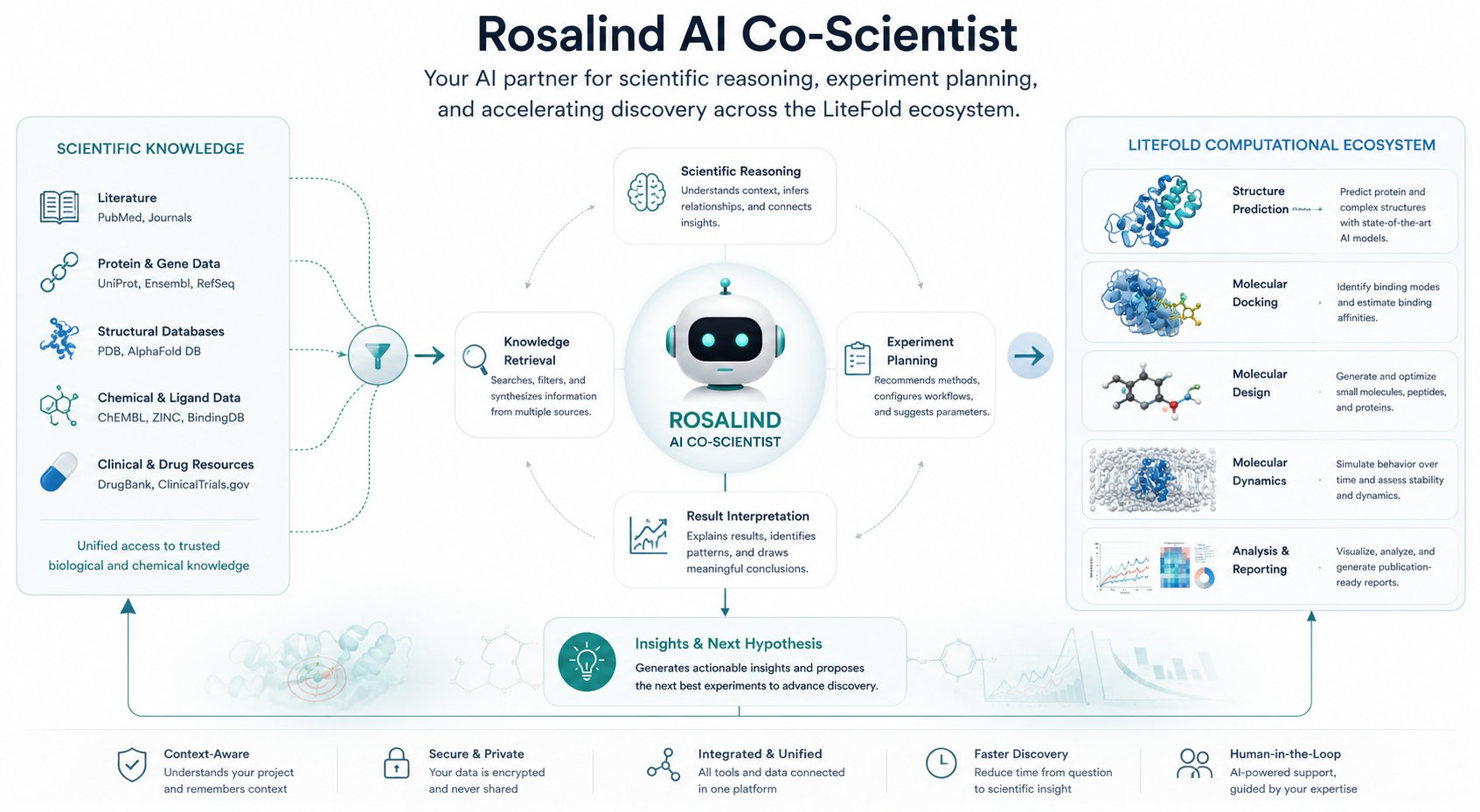
Integrated directly into LiteFold, Rosalind acts as an AI co-scientist that supports researchers throughout the entire discovery process. Rather than functioning as a standalone chatbot, Rosalind understands the scientific context of your projects, helping you search biological knowledge, configure computational experiments, explain complex results, and recommend logical next steps based on your ongoing research.
 ## More Than an AI Assistant
Rosalind is deeply integrated into every stage of the LiteFold platform.
Instead of requiring researchers to manually search databases, configure software, interpret computational outputs, and move information between independent tools, Rosalind brings these capabilities together within a single conversational interface.
As projects evolve, Rosalind remains aware of uploaded structures, generated molecules, simulation results, docking experiments, and previous conversations. This allows recommendations to remain connected to the broader scientific context rather than treating every question as an isolated request.
The result is a research assistant capable of supporting scientific reasoning throughout an entire project instead of simply answering individual questions.
## A Scientific Research Companion
Rosalind supports the complete lifecycle of computational drug discovery.
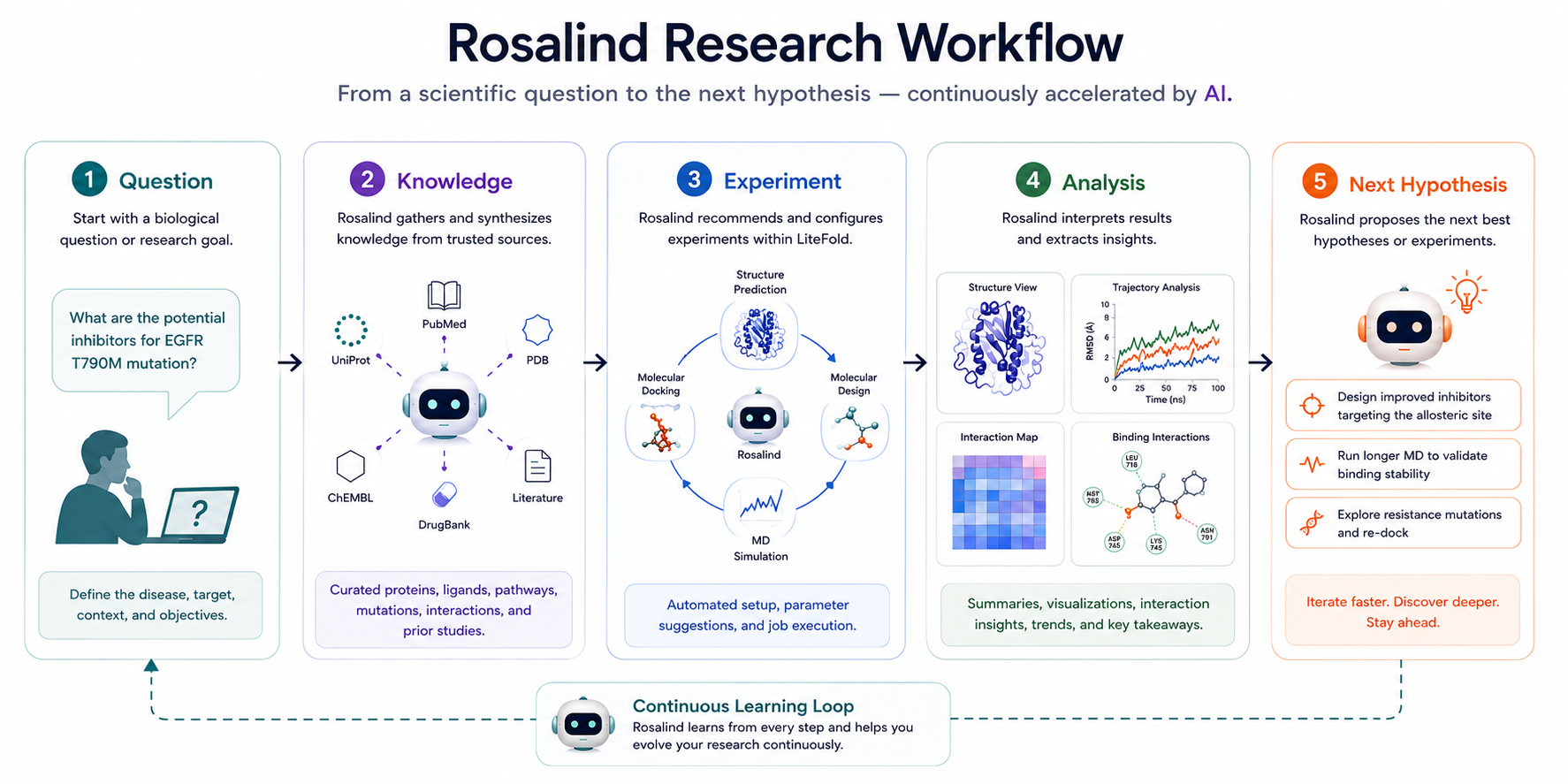
Research may begin with a biological question, such as identifying proteins associated with a disease or understanding the effect of a particular mutation. Rosalind can retrieve relevant biological knowledge, suggest computational approaches, and help determine the most appropriate LiteFold workflow for the problem.
As experiments progress, Rosalind continues to assist by interpreting structural predictions, explaining molecular interactions, analyzing simulation results, and recommending additional experiments that build upon previous findings.
Rather than replacing scientific decision-making, Rosalind provides computational assistance that enables researchers to move more efficiently between hypothesis generation, experimentation, and interpretation.
## More Than an AI Assistant
Rosalind is deeply integrated into every stage of the LiteFold platform.
Instead of requiring researchers to manually search databases, configure software, interpret computational outputs, and move information between independent tools, Rosalind brings these capabilities together within a single conversational interface.
As projects evolve, Rosalind remains aware of uploaded structures, generated molecules, simulation results, docking experiments, and previous conversations. This allows recommendations to remain connected to the broader scientific context rather than treating every question as an isolated request.
The result is a research assistant capable of supporting scientific reasoning throughout an entire project instead of simply answering individual questions.
## A Scientific Research Companion
Rosalind supports the complete lifecycle of computational drug discovery.
Research may begin with a biological question, such as identifying proteins associated with a disease or understanding the effect of a particular mutation. Rosalind can retrieve relevant biological knowledge, suggest computational approaches, and help determine the most appropriate LiteFold workflow for the problem.
As experiments progress, Rosalind continues to assist by interpreting structural predictions, explaining molecular interactions, analyzing simulation results, and recommending additional experiments that build upon previous findings.
Rather than replacing scientific decision-making, Rosalind provides computational assistance that enables researchers to move more efficiently between hypothesis generation, experimentation, and interpretation.
 ## Scientific Knowledge at Your Fingertips
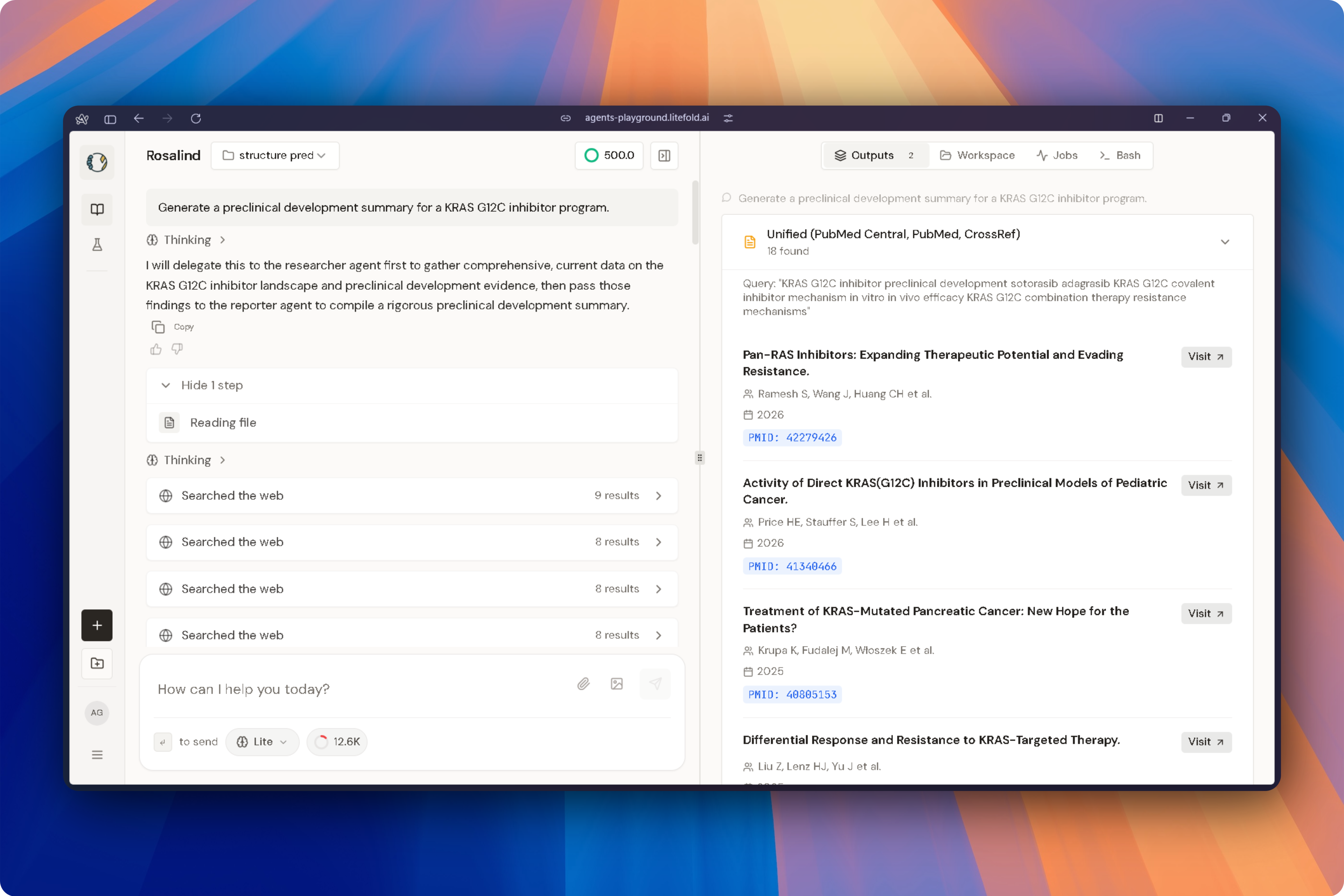
Biological research depends on information distributed across numerous public resources. Finding and connecting this information can often become one of the most time-consuming parts of a project.
Rosalind streamlines this process by bringing together knowledge from widely used biological and chemical databases within a single interface. Researchers can retrieve protein annotations, structural information, ligand data, literature references, and experimental evidence without leaving the LiteFold workspace.
Instead of performing multiple independent searches, Rosalind organizes relevant information into a coherent scientific context that can immediately support downstream computational workflows.
## Scientific Knowledge at Your Fingertips
Biological research depends on information distributed across numerous public resources. Finding and connecting this information can often become one of the most time-consuming parts of a project.
Rosalind streamlines this process by bringing together knowledge from widely used biological and chemical databases within a single interface. Researchers can retrieve protein annotations, structural information, ligand data, literature references, and experimental evidence without leaving the LiteFold workspace.
Instead of performing multiple independent searches, Rosalind organizes relevant information into a coherent scientific context that can immediately support downstream computational workflows.
 ## Assisting Every LiteFold Workflow
Rosalind works alongside every computational module available within LiteFold.
During Structure Prediction, Rosalind can recommend appropriate prediction models, retrieve protein sequences, compare homologous structures, and help interpret confidence metrics.
Within Molecular Docking, Rosalind assists with identifying candidate binding pockets, selecting ligands, comparing interaction patterns, and explaining docking scores in structural context.
During protein and molecular design workflows, Rosalind helps define design objectives, interpret hotspot regions, explain scaffold strategies, and review generated candidates before further optimization.
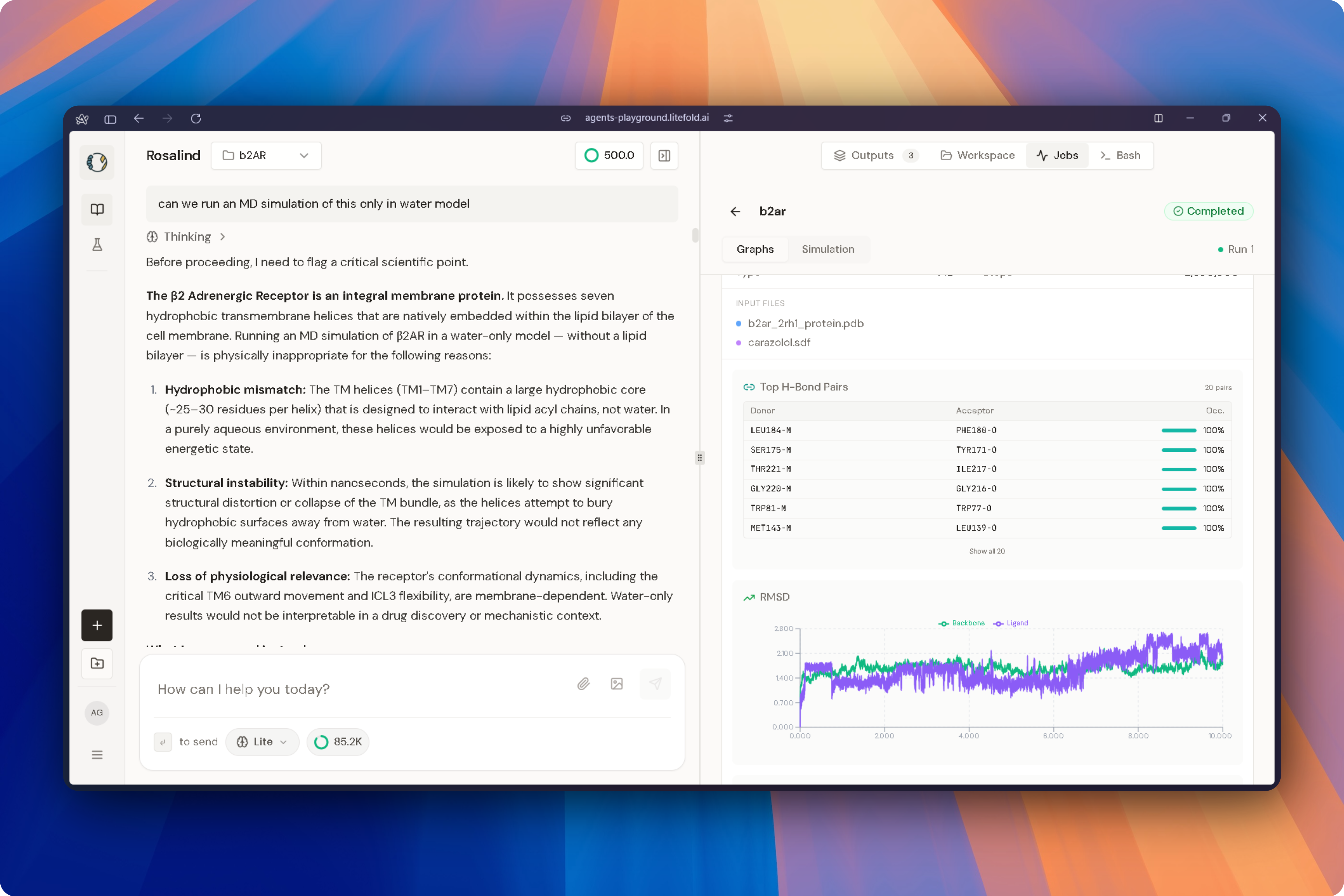
For Molecular Dynamics simulations, Rosalind assists with understanding trajectory behavior, explaining RMSD and RMSF trends, monitoring hydrogen-bond networks, and identifying structural events that may influence biological function.
Because Rosalind remains connected to every experiment within the project, recommendations continue to evolve as new computational results become available.
## Assisting Every LiteFold Workflow
Rosalind works alongside every computational module available within LiteFold.
During Structure Prediction, Rosalind can recommend appropriate prediction models, retrieve protein sequences, compare homologous structures, and help interpret confidence metrics.
Within Molecular Docking, Rosalind assists with identifying candidate binding pockets, selecting ligands, comparing interaction patterns, and explaining docking scores in structural context.
During protein and molecular design workflows, Rosalind helps define design objectives, interpret hotspot regions, explain scaffold strategies, and review generated candidates before further optimization.
For Molecular Dynamics simulations, Rosalind assists with understanding trajectory behavior, explaining RMSD and RMSF trends, monitoring hydrogen-bond networks, and identifying structural events that may influence biological function.
Because Rosalind remains connected to every experiment within the project, recommendations continue to evolve as new computational results become available.
 ## From Conversation to Computation
Rosalind understands scientific questions expressed in natural language.
A researcher might begin by asking for proteins associated with a particular disease, continue by requesting structure prediction for a selected target, perform molecular docking against known ligands, validate promising complexes using molecular dynamics simulations, and finally generate a report summarizing the complete study.
Throughout this process, Rosalind preserves the context of the conversation, allowing subsequent requests to build naturally upon previous analyses without requiring researchers to repeatedly specify experimental details.
This conversational workflow transforms complex computational pipelines into intuitive scientific discussions.
## From Conversation to Computation
Rosalind understands scientific questions expressed in natural language.
A researcher might begin by asking for proteins associated with a particular disease, continue by requesting structure prediction for a selected target, perform molecular docking against known ligands, validate promising complexes using molecular dynamics simulations, and finally generate a report summarizing the complete study.
Throughout this process, Rosalind preserves the context of the conversation, allowing subsequent requests to build naturally upon previous analyses without requiring researchers to repeatedly specify experimental details.
This conversational workflow transforms complex computational pipelines into intuitive scientific discussions.
 ## Context-Aware Scientific Reasoning
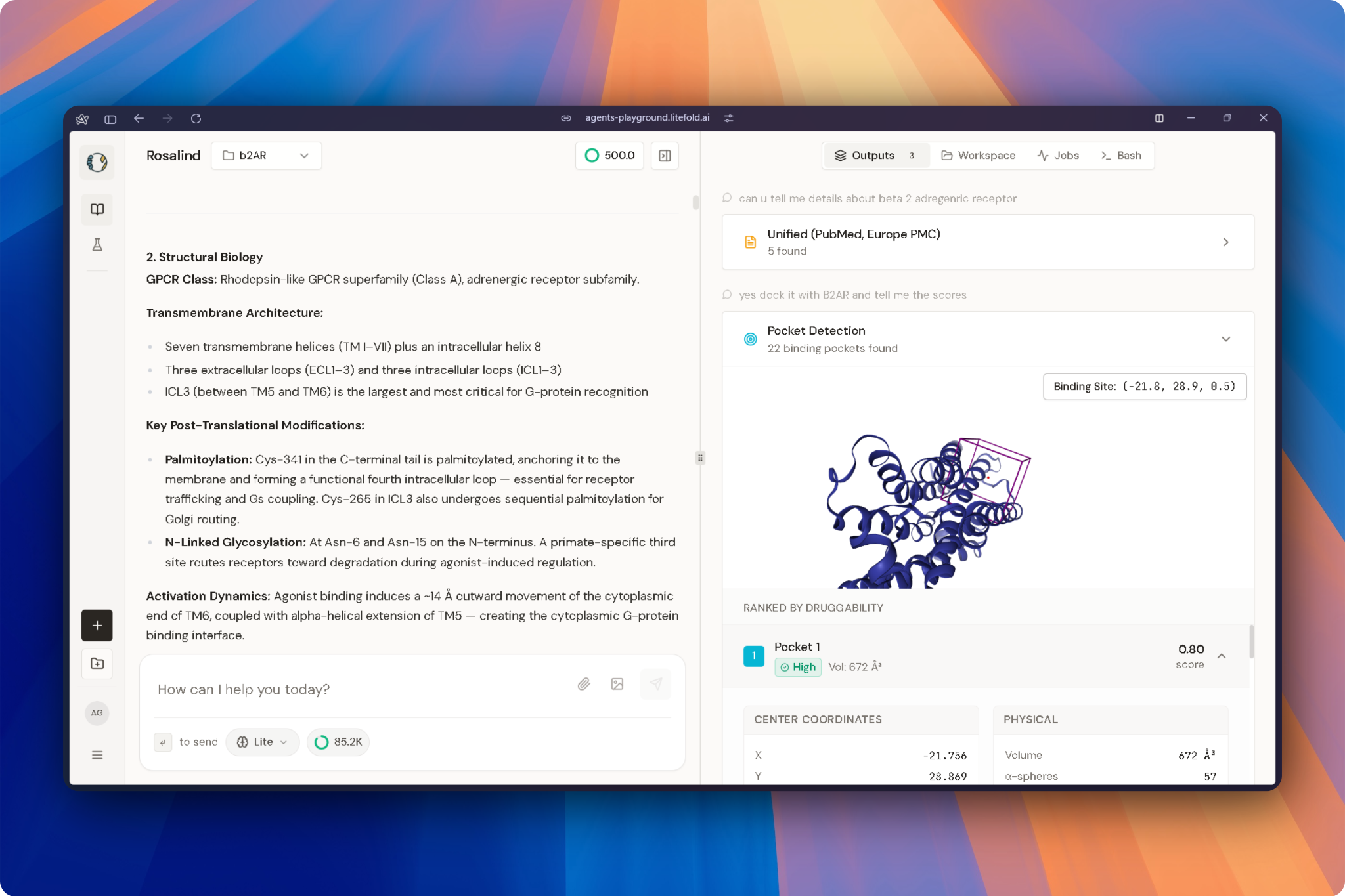
Unlike traditional search tools, Rosalind continuously incorporates information generated during ongoing research.
Structures predicted earlier in a project become available during docking studies. Docking results influence molecular design decisions. Simulation outputs contribute to later optimization strategies. Throughout each stage, Rosalind connects these independent analyses into a coherent research narrative.
By understanding relationships between experiments rather than individual outputs alone, Rosalind helps researchers identify meaningful patterns that might otherwise remain hidden across separate computational workflows.
## Context-Aware Scientific Reasoning
Unlike traditional search tools, Rosalind continuously incorporates information generated during ongoing research.
Structures predicted earlier in a project become available during docking studies. Docking results influence molecular design decisions. Simulation outputs contribute to later optimization strategies. Throughout each stage, Rosalind connects these independent analyses into a coherent research narrative.
By understanding relationships between experiments rather than individual outputs alone, Rosalind helps researchers identify meaningful patterns that might otherwise remain hidden across separate computational workflows.
 ## Human Expertise Remains Central
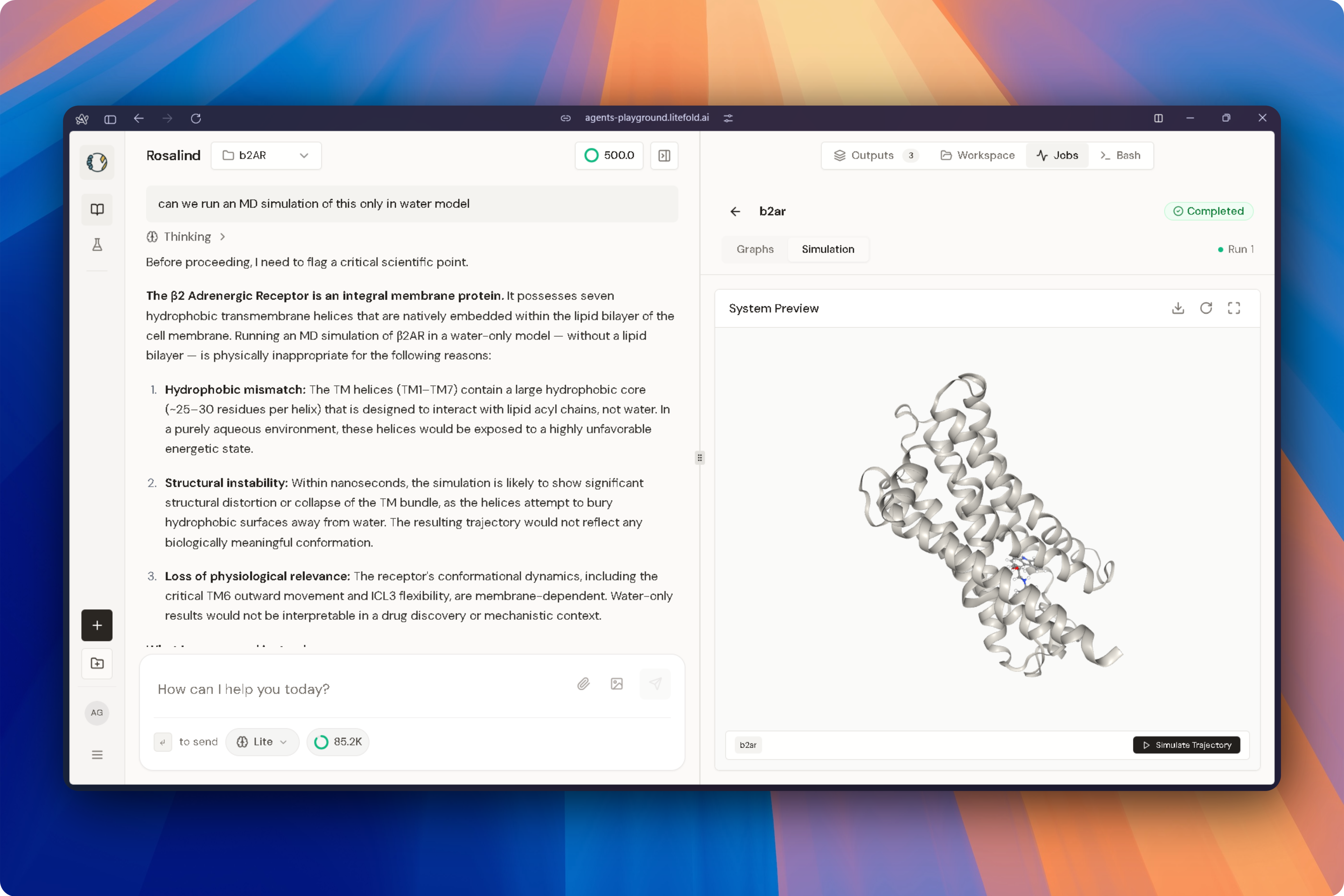
Rosalind is designed to augment scientific expertise rather than replace it.
Its recommendations are intended to support researchers by reducing repetitive computational tasks, organizing scientific information, and accelerating hypothesis generation. Final experimental decisions, biological interpretation, and scientific validation remain the responsibility of the researcher.
This collaborative approach combines the efficiency of artificial intelligence with the experience and critical thinking of domain experts.
## Human Expertise Remains Central
Rosalind is designed to augment scientific expertise rather than replace it.
Its recommendations are intended to support researchers by reducing repetitive computational tasks, organizing scientific information, and accelerating hypothesis generation. Final experimental decisions, biological interpretation, and scientific validation remain the responsibility of the researcher.
This collaborative approach combines the efficiency of artificial intelligence with the experience and critical thinking of domain experts.
 ## Best Practices
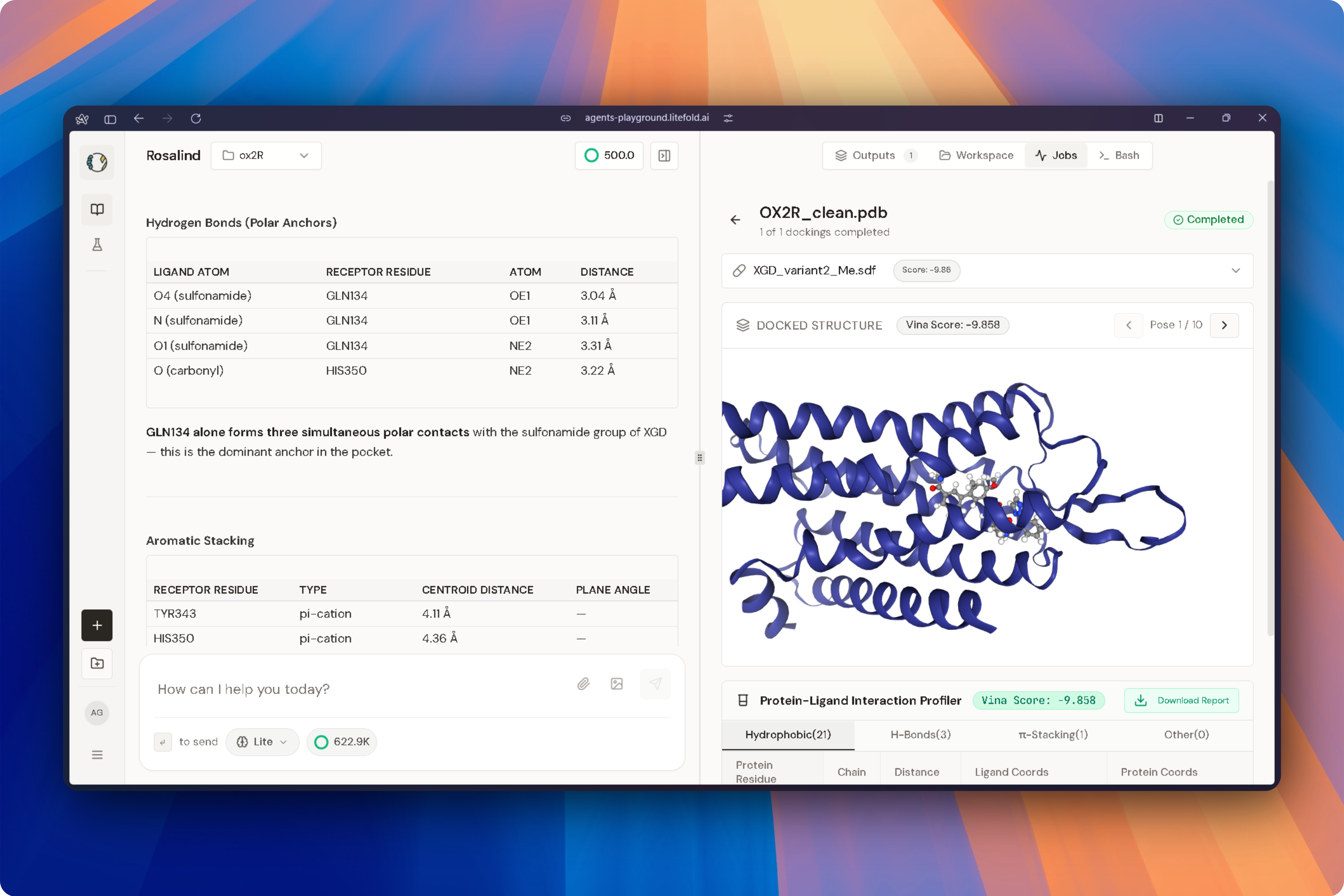
Rosalind performs best when provided with sufficient scientific context. Clearly describing research objectives, target proteins, disease models, or experimental goals allows the platform to generate more relevant recommendations and configure more appropriate computational workflows.
Rather than limiting interactions to isolated questions, researchers are encouraged to maintain continuous conversations throughout a project. Because Rosalind retains experimental context, follow-up discussions become progressively more informative as additional computational results are generated.
Although Rosalind can automate many aspects of computational research, important scientific conclusions should always be interpreted alongside experimental evidence and domain expertise.
## Continue Exploring
Rosalind works seamlessly across the entire LiteFold ecosystem. Continue exploring the documentation to learn how it integrates with Structure Prediction, Molecular Docking, Design, De Novo Drug Design, and Molecular Dynamics to support complete end-to-end computational discovery workflows.
How Rosalind helped design novel EGFR inhibitors for resistant mutations
Using Rosalind for high-throughput virtual screening campaigns
## Feedback and Feature Requests
Have ideas for how Rosalind could be more helpful? We'd love to hear from you!
Email us at [support@litefold.ai](mailto:support@litefold.ai) with feedback or feature requests.
## Best Practices
Rosalind performs best when provided with sufficient scientific context. Clearly describing research objectives, target proteins, disease models, or experimental goals allows the platform to generate more relevant recommendations and configure more appropriate computational workflows.
Rather than limiting interactions to isolated questions, researchers are encouraged to maintain continuous conversations throughout a project. Because Rosalind retains experimental context, follow-up discussions become progressively more informative as additional computational results are generated.
Although Rosalind can automate many aspects of computational research, important scientific conclusions should always be interpreted alongside experimental evidence and domain expertise.
## Continue Exploring
Rosalind works seamlessly across the entire LiteFold ecosystem. Continue exploring the documentation to learn how it integrates with Structure Prediction, Molecular Docking, Design, De Novo Drug Design, and Molecular Dynamics to support complete end-to-end computational discovery workflows.
How Rosalind helped design novel EGFR inhibitors for resistant mutations
Using Rosalind for high-throughput virtual screening campaigns
## Feedback and Feature Requests
Have ideas for how Rosalind could be more helpful? We'd love to hear from you!
Email us at [support@litefold.ai](mailto:support@litefold.ai) with feedback or feature requests.